

By nirza panchal On 19-12-2025 at 11:29 am
What Are Hybrid Cars? Types, How They Work & Key Advantages
For many years, car buyers only had to choose between petrol and diesel engines. Today, with the rise of CNG, electric vehicles, and hybrid cars, the automotive market offers far more choices than ever before. Among these options, hybrid cars are gaining strong popularity as they balance fuel efficiency, performance, and lower environmental impact.
Hybrid vehicles appeal to buyers who want better mileage and reduced emissions without fully relying on charging infrastructure. This blog explains what hybrid cars are, how they work, their types, features, advantages, disadvantages, and common FAQs.
How Do Hybrid Cars Work?
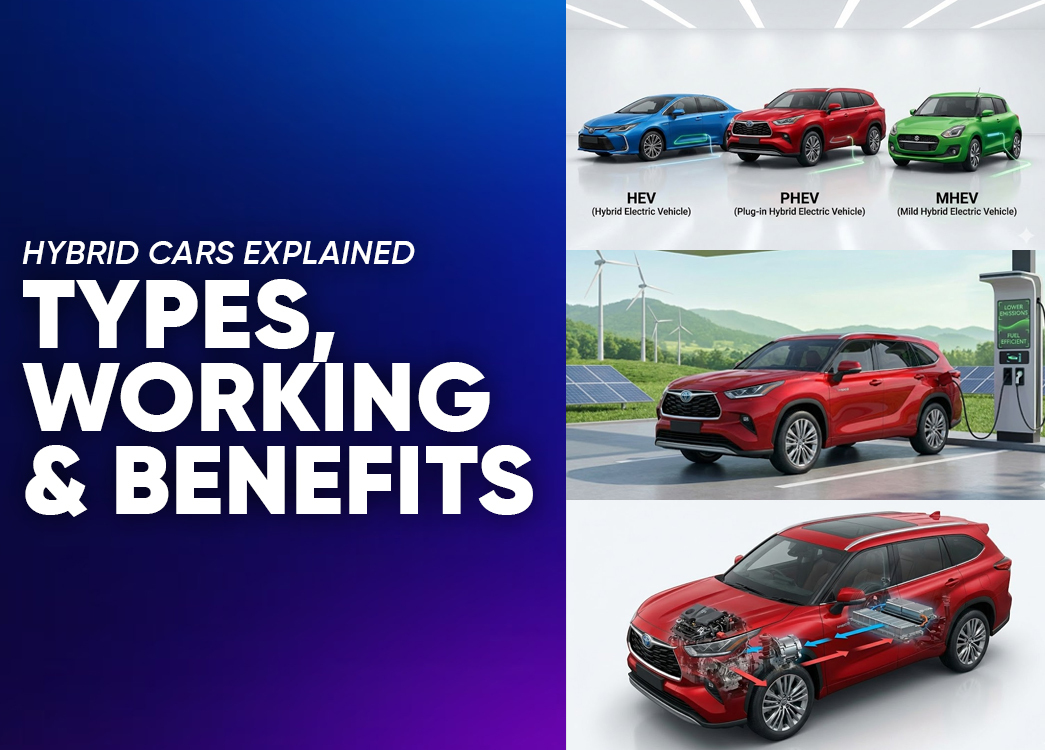
Hybrid cars use both an internal combustion engine (ICE) and an electric motor to power the vehicle. Depending on driving conditions, either one or both systems operate together to deliver optimal efficiency and performance.
At low speeds and in stop-and-go traffic, the electric motor usually powers the car, reducing fuel usage and emissions. During acceleration or highway driving, the engine takes over or works alongside the electric motor.
All hybrid cars feature regenerative braking, which converts braking energy into electricity to recharge the battery instead of wasting it as heat.
Types of Hybrid Cars
Hybrid cars are classified based on how the engine and electric motor work together.
1. Full Hybrids
Full hybrid cars can run on electric power alone, engine power alone, or a combination of both.
Parallel Hybrids: Both the engine and electric motor are connected to the wheels and can power the car independently or together. These are highly efficient in city driving.
Series Hybrids: The electric motor drives the wheels, while the engine generates electricity to power the motor or recharge the battery.
2. Mild Hybrids
Mild hybrids use a small electric motor to assist the engine but cannot run on electric power alone. They improve fuel efficiency and reduce emissions at a lower cost.
3. Plug-in Hybrids (PHEVs)
Plug-in hybrids have larger batteries that can be charged externally. They offer a longer electric-only driving range and switch to hybrid mode once the battery is depleted.
Key Features of Hybrid Cars
Regenerative Braking
This system recovers energy during braking and stores it in the battery, improving efficiency and reducing brake wear.
Start-Stop System
The engine automatically shuts off during idling and restarts when needed. In hybrids, the electric motor can move the car at low speeds without engine assistance.
Electric Motor Assist
The electric motor provides instant torque during acceleration, reducing engine load and improving performance.
Eco Driving Modes
Eco modes optimize engine and motor usage to maximize fuel savings and minimize emissions, especially in city driving.
Main Components of a Hybrid Car
Internal Combustion Engine: Provides power at higher speeds and helps charge the battery in some systems.
Electric Motor: Drives the car at low speeds and assists during acceleration.
Battery Pack: Stores electrical energy and supports frequent charging cycles.
Power Control Unit: Manages energy flow between the engine, motor, and battery.
Transmission: Transfers power to the wheels using systems like CVT or dual-clutch transmissions.
Advantages of Hybrid Cars
Hybrid vehicles offer better fuel efficiency, lower emissions, reduced fuel dependence, smoother driving, and lower long-term running costs.
Disadvantages of Hybrid Cars
Hybrid cars generally have a higher upfront cost, limited electric-only range, expensive battery replacement, complex maintenance, and reduced cargo space due to battery placement.
Are Hybrid Cars Worth It?
Hybrid cars are a practical step toward sustainable mobility. While they cost more initially, their long-term fuel savings, reduced emissions, and improved technology make them a smart choice for modern drivers.
FAQs About Hybrid Cars
How long does a hybrid car battery last?
Most hybrid batteries last between 8 to 10 years, depending on driving habits and conditions.
Are hybrid cars suitable for long trips?
Yes, hybrid cars are ideal for both city and highway driving, as the engine takes over when the battery is low.
Do hybrid cars require special servicing?
Hybrid cars need regular servicing similar to conventional vehicles, with additional checks for the battery and electrical systems.
Can hybrid cars run only on electricity?
Plug-in hybrids can run on electric power alone for short distances before switching to engine power.
Do hybrid cars perform well compared to conventional cars?
Modern hybrid cars offer smooth acceleration, comparable performance, and improved fuel efficiency.

Author
nirza panchal
Related posts